
Spring Wasp and Bee Nest Season in Pembroke Pines, FL: Where to Look First
Spring Wasp and Bee Nest Season in Pembroke Pines, FL: Where to Look First
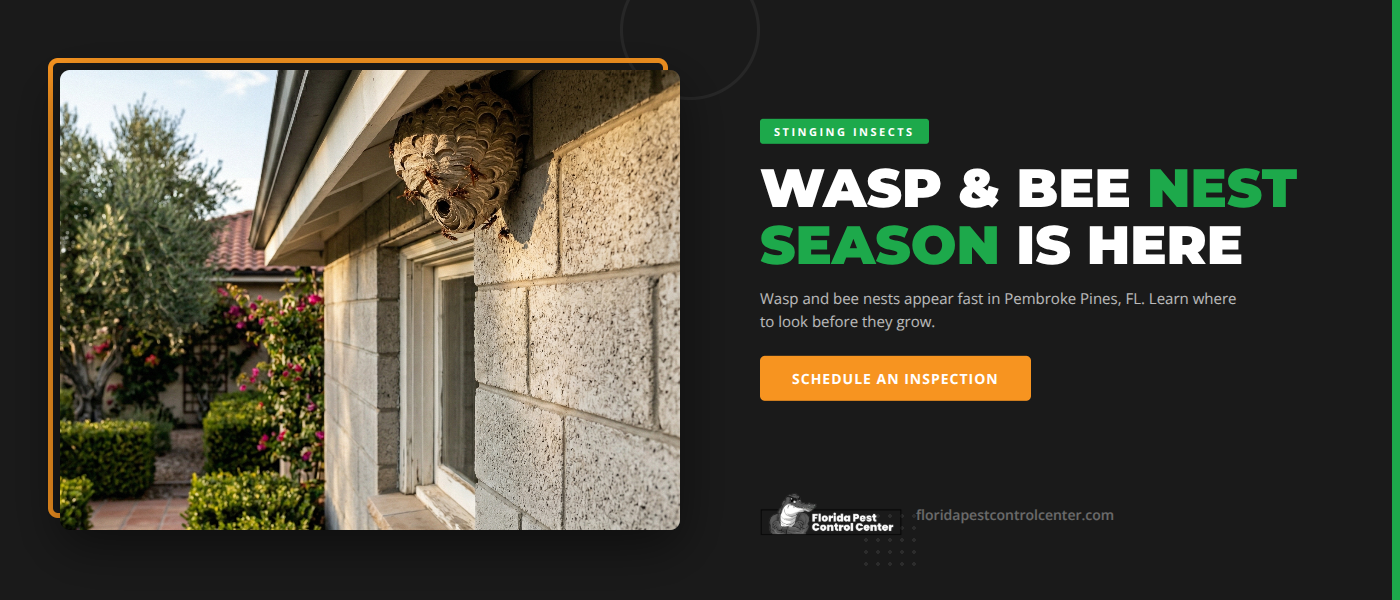
If you have noticed paper wasps drifting under the eaves or watched bees pour in and out of a soffit gap, spring is the reason. Across Pembroke Pines, the warm, humid stretch from March through June is when stinging insects scout, nest, and grow their colonies fastest. At Florida Pest Control Center, we field more wasp control Pembroke Pines calls in spring than any other season. Knowing where to look and when to step back keeps a small new nest from becoming a backyard hazard.
Why Wasps and Bees Become Active in Pembroke Pines Each Spring
Stinging insects in South Florida do not truly hibernate. Mild winters, year-round flowering plants, and humid coastal weather mean queens, workers, and overwintering adults stay alive in pockets all year. What changes in spring is intensity. According to the University of Florida IFAS Extension, paper wasp and yellowjacket queens that survived winter begin scouting nest sites as soon as daytime temperatures climb consistently into the 70s and 80s — exactly what Pembroke Pines sees from late February through May.
Once a queen finds a sheltered location, she lays the first eggs and builds a small papery comb on her own. Within a few weeks, the first workers emerge and the colony grows quickly. By midsummer, a single golf-ball-sized nest from March can become a basketball-sized structure with hundreds of stinging defenders — which is why the small nest you spot in April matters.
Pembroke Pines properties are especially attractive in spring. Stucco eaves and soffits offer dry, protected nesting cavities. Screened pool enclosures provide shaded undersides for paper wasp combs. Mature landscaping and dense hedges shelter ground-nesting yellowjackets. Neighborhoods near Chapel Trail, Silver Lakes, and the C-9 canal also see seasonal honey bee swarming as feral colonies divide. Spring is when colonies are still small enough to address quickly.
Common Stinging Insects Found Around South Florida Homes
Several stinging insects nest in and around Pembroke Pines, FL homes, and they do not all behave the same way. Identifying the species is the first step in any effective wasp control Pembroke Pines plan.
Paper wasps — The most common stinging insect we encounter in Pembroke Pines yards. Slender, brown to reddish brown, with long dangling legs in flight. They build open, umbrella-shaped paper combs under eaves, in soffits, in patio ceilings, and inside grills or mailboxes. Less aggressive than yellowjackets, but they defend the nest vigorously when disturbed.
Yellowjackets — Shorter, stockier, with bright yellow and black banding. Yellowjackets nest in the ground, in wall voids, and inside cavities like old rodent burrows. Of all the stinging insects we treat in South Florida, yellowjackets account for the highest share of multiple-sting incidents, and their colonies can hold thousands of workers by late summer.
Mud daubers — Long, slender, often metallic blue or black wasps that build small mud tubes on stucco walls and inside sheds. They are largely solitary, rarely sting, and feed primarily on spiders.
Honey bees — Furry, golden-brown, and notably smaller than most wasps. Honey bees in South Florida swarm in spring as colonies divide. Swarms cluster temporarily on tree limbs or eaves before settling into a permanent cavity such as a soffit, attic, or wall void. Florida is a designated Africanized honey bee zone, which is why any established bee colony inside a home should be handled by a licensed professional.
Carpenter bees — Large, shiny, mostly black bees that bore perfectly round half-inch holes into unpainted wood — fascia boards, deck rails, and pergolas. They rarely sting, but the structural damage from repeated tunneling is the real concern.
Treatments that work for paper wasps are not right for yellowjackets, and a honey bee colony in a wall is a completely different project from a wasp nest under an eave. That is why our Pembroke Pines inspections begin with positive identification.
Top Nesting Spots Around Pembroke Pines Properties
Wasps and bees are remarkably good at finding sheltered, defensible cavities. After years of wasp and bee work in Pembroke Pines, we know where to look first:
Roof and eave level:
- Under soffits and along the underside of eaves — the number-one paper wasp location
- Inside attic, gable, and ridge vents with torn or missing screens
- Inside Spanish tile roofing — a common honey bee cavity
- In the corners and trusses of screened pool enclosures
Wall and exterior level:
- Inside wall voids accessed through stucco cracks or utility penetrations
- Behind decorative shutters that are rarely closed
- Inside electrical meter boxes, irrigation valve boxes, and pool equipment housings
- In hose reels, grills, mailboxes, and patio furniture left undisturbed
- Bored into unpainted fascia, deck rails, and pergolas (carpenter bees)
Ground and landscape level:
- Abandoned rodent burrows and ground cavities (yellowjackets)
- Under thick hedges, palm skirts, and dense ground cover
- Inside sheds, under porches, and around pool equipment or AC condensers
A complete inspection looks at all three levels — the visible nest is often only one of several active sites.
Warning Signs of an Active Nest You Should Not Ignore
Most Pembroke Pines homeowners do not notice a stinging insect problem until the nest is established. The warning signs almost always appear before a sting does — if you know what to watch for.
- Steady traffic to a single point on the home: A consistent line of wasps or bees in and out of one soffit gap, vent, or wall opening is the clearest sign of an active colony inside.
- A papery comb or mud tube: Visible paper wasp combs or mud dauber tubes confirm an active nest, and small combs grow quickly in spring.
- A loud, low buzz from a wall or ceiling: Often the first indicator of a honey bee colony inside a soffit or wall void.
- Sudden wasp activity around a single shrub or lawn area: A telltale yellowjacket ground nest sign — the entrance hole is often surprisingly small.
- Round half-inch holes in fascia or deck wood: Carpenter bee tunneling, often with yellow sawdust on the ground beneath.
- Wasps inside the home: Indoor wasps usually mean a wall-void nest with an exterior entry — not a casual visitor through an open door.
If you spot any of these in your Pembroke Pines yard this spring, do not wait. Colonies grow exponentially through the warm months, and earlier action means smaller treatment and less risk to your household.
Why DIY Nest Removal Often Goes Wrong in Florida Backyards
Store-bought wasp sprays look reassuring on the can, but in real Pembroke Pines yards, DIY removal frequently goes wrong.
Sprays do not reach inside the structure. A nest under a soffit looks small from the patio, but the active colony often extends deep into the soffit cavity or wall void. Aerosol kills the visible workers and aggravates the rest, leaving a frustrated colony that simply rebuilds.
Yellowjacket ground nests are a particularly bad target for spray cans. Pouring spray into a ground hole sends hundreds of workers boiling out at once — most of the multiple-sting incidents we hear about in South Florida start this way.
Honey bee colonies need live removal, not pesticide. Pesticide-killed colonies leave honey, comb, and decomposing bees inside walls, which attracts other pests and damages drywall. The Florida Department of Agriculture and Consumer Services recommends licensed professional removal for any in-structure honey bee colony.
Ladders and stings combine badly. The Centers for Disease Control and Prevention identifies stinging insects as a leading cause of outdoor sting-related emergency visits, and the most serious incidents happen when someone reacts suddenly on a ladder. Anaphylaxis can also develop after years of mild reactions, so a large or in-structure nest is not the place to test sting tolerance.
For a small, isolated mud dauber nest, a homeowner can usually handle it. For anything larger, ground-nesting, in-wall, or unidentified, professional removal is the gentler choice for everyone.
When to Call a Local Pembroke Pines Pest Pro
Call a professional before the colony grows large or moves into the structure. We recommend Pembroke Pines homeowners reach out as soon as any of the following are true:
- Steady wasp or bee traffic in and out of one point on the home
- Buzzing inside a wall, ceiling, or soffit
- A paper nest larger than a tennis ball anywhere on the property
- A ground nest in a yard with children or pets
- Carpenter bees tunneling into fascia, decking, or pergolas
- A household member with a known stinging insect allergy
A professional inspection in Pembroke Pines includes a full exterior walk-around at all three levels, species identification, nest mapping, and a treatment plan tailored to the species. For paper wasps and yellowjackets, we use targeted treatment at the nest entry point, comb removal after the colony is inactive, and exclusion repairs. For honey bees, we coordinate live removal when the cavity allows. For carpenter bees, we treat the galleries and recommend sealing the affected wood.
Florida Pest Control Center has protected Pembroke Pines properties for years, and we serve the surrounding Broward County communities — including Miramar, Cooper City, Davie, Hollywood, and Pembroke Park. Local experience matters: we know which neighborhoods see heavy yellowjacket pressure each spring.
Frequently Asked Questions About Wasp Control in Pembroke Pines, FL
Why do I see so many wasps under my Pembroke Pines eaves in spring?
Spring is when overwintered paper wasp queens scout nest sites and begin building. South Florida's mild winter and humid spring let them start much earlier than wasps in cooler regions, and Pembroke Pines stucco eaves provide ideal sheltered nesting cavities. The visible nest in April is the foundation of the much larger colony you would see by midsummer if it is left alone.
How can I tell if I have a wasp nest or a bee colony in my Pembroke Pines wall?
Two clues help. Wasps have slender, mostly hairless bodies and dangling legs in flight; honey bees are smaller, fuzzy, and golden brown. Sound is the second clue — a steady, low, deep buzz from a wall or ceiling typically indicates a honey bee colony, while paper wasps and yellowjackets are more often heard intermittently as workers come and go. A professional inspection confirms the species, which determines the right treatment plan.
Is DIY wasp spray effective on a nest under my soffit?
For a small, exposed paper wasp comb, an aerosol applied at dusk will sometimes do the job. For nests inside soffits, vents, walls, or the ground, store-bought sprays usually fail to reach the colony and tend to provoke aggressive defensive behavior. Professional wasp control in Pembroke Pines uses application methods that reach the nest interior the first time and avoid the multi-sting risk of homeowner attempts.
Should a honey bee swarm be removed or left alone?
A swarm clustered briefly on a tree branch or fence will usually move on within a day or two on its own. An established colony inside a soffit, wall void, or attic should be addressed by a licensed professional — pesticide-only removal leaves honey, wax, and decomposing bees in the structure, and Florida's Africanized honey bee status makes in-structure colonies a poor DIY target.
How long does professional wasp and bee removal take in Pembroke Pines?
Most paper wasp and yellowjacket nests are resolved in a single visit. Honey bee live removal typically takes one or two visits depending on the cavity and comb size. Our team provides a realistic timeline after the initial inspection.
Take Action Against Spring Wasp and Bee Season in Pembroke Pines, FL
Spring stinging insect pressure in Pembroke Pines is predictable, but a serious nest problem is not. The earlier you address the first signs, the smaller the treatment and the lower the risk to your household.
Florida Pest Control Center has helped Pembroke Pines homeowners protect their properties season after season. When you need experienced wasp control in Pembroke Pines, we are ready.
Contact Florida Pest Control Center today and keep wasps and bees off your property this spring.